Is VoltRush legit in Australia? A layered trust check
 Available in US
Trust and due diligence
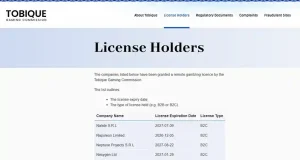
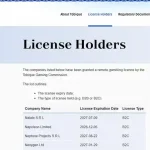
VoltRush is operated by Neptune Projects S.R.L., a company currently listed by the Tobique Gaming Commission as a B2C licence holder. That offshore licence record is evidence of an identifiable operator and a licensing relationship. In the Australian context, ACMA also issued Neptune Projects a formal warning in 2026 over the separate Vegastars service. Those facts matter more than a simple “legit” label.
There are also product-level safeguards worth noting: VoltRush publishes KYC rules, responsible-gambling controls and 24/7 support. At the same time, its small Trustpilot profile was rated 2.5/5 from six reviews when checked, so reputation evidence is limited and negative rather than strong. That is a warning signal to weigh, not proof of fraud.
Table of Contents
- Start with the operator, not the branding
- Tobique licensing is evidence, but not Australian authorisation
- What ACMA context changes for an Australian reader
- The Neptune Projects enforcement history is relevant, but brand-specific limits matter
- KYC and account controls provide procedural safeguards
- BetStop is not a substitute for checking offshore-casino controls
- How much weight should six Trustpilot reviews carry?
- Security claims are useful only when tied to player behaviour
- A practical trust checklist before depositing
- What would strengthen confidence from here?
- The evidence that matters most when judging VoltRush in Australia
- Is VoltRush legit in Australia? A layered trust check
Start with the operator, not the branding
The first useful trust check is whether a casino can be tied to a named legal operator. VoltRush states that Neptune Projects S.R.L. operates the website, and the same operator name appears on the Tobique Gaming Commission’s current B2C licence-holder list. That consistency gives the brand a traceable operating entity rather than leaving readers with only a marketing name.
However, traceability is not the same thing as local approval. A foreign licence can tell you who is responsible for the service and which offshore regulator claims jurisdiction over the operator. It does not automatically grant permission to offer every product in Australia. The detailed VoltRush licence separates those records source by source.
Tobique licensing is evidence, but not Australian authorisation
The Tobique Gaming Commission’s holder register currently lists Neptune Projects S.R.L. as holding a B2C remote gambling licence with an expiry date of 22 August 2027. VoltRush itself publicly states that it is licensed by Tobique and displays licence number 0000020. The public holder-list view we checked, however, did not visibly connect that exact number or the VoltRush domain to the Neptune row.
That distinction is easy to miss. The strong claim supported by the register is that the named operator is a current Tobique B2C licence holder. The weaker claim is the precise mapping between VoltRush’s displayed number and the public register row, because that linkage was not visible in the accessible register output. Treating those as two separate propositions is more accurate than collapsing them into “licensed, therefore approved everywhere”.
For readers who want the record-level detail, the VoltRush Licence page shows what the Tobique and Australian checks establish and where the evidence stops.
What ACMA context changes for an Australian reader
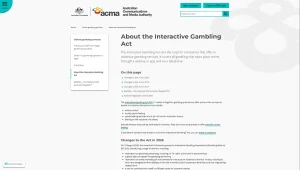
ACMA says the Interactive Gambling Act makes it illegal for gambling providers to offer certain online services to people in Australia, including online casinos. Its public register is for licensed interactive wagering providers, which is a different category from an offshore casino licence. VoltRush and Neptune Projects were not verified on that Australian register when checked.
This is why a trust review should not translate “the site loads in Australia” or “AUD appears in the cashier” into an Australian approval claim. Availability, foreign licensing and local legal authorisation answer different questions. Our dedicated guide to VoltRush and Australian Online Casino Law handles the statutory framework without turning this page into a legal essay. Questions about winnings and record keeping are treated separately in the VoltRush tax Australia guide, because tax treatment is not evidence of casino licensing or approval.
The Neptune Projects enforcement history is relevant, but brand-specific limits matter
In 2026 ACMA issued Neptune Projects S.R.L. a formal warning over Vegastars, a separate service operated by the same company. ACMA found that Vegastars had an Australian customer link and that Neptune Projects had provided prohibited interactive gambling services to customers physically present in Australia. ACMA also included Vegastars in a website-blocking announcement.
That enforcement history is directly relevant to assessing the operator because it concerns the same legal entity. It should not be rewritten as a finding that ACMA has taken the same action against VoltRush unless there is a VoltRush-specific notice. The useful inference is narrower: the operator has a documented Australian regulatory enforcement event involving another casino service, so Australian readers have a concrete reason to examine local-regulation risk rather than relying only on the offshore licence badge.
KYC and account controls provide procedural safeguards
Trust is not only about licences. VoltRush publishes a KYC policy and can require identity verification before processing withdrawals. The current policy also sets identifiable verification triggers and document expectations, which are covered in the dedicated VoltRush KYC guide. Publishing a process does not guarantee that every case will be frictionless, but it gives users a defined compliance framework to inspect before depositing.
VoltRush also promotes account-level responsible-gambling tools including deposit limits, time-outs, reality checks and self-exclusion. These are meaningful controls because they let a player restrict access or activity from inside the service rather than relying solely on willpower after spending has already escalated.
BetStop is not a substitute for checking offshore-casino controls
Australian readers may know BetStop as the national self-exclusion register. Its scope is important: ACMA describes BetStop as covering Australian licensed online and phone wagering providers. It should not be presented as a universal block across offshore online casinos.
For VoltRush, the practical safeguard is therefore the site’s own self-exclusion and account-control process, plus any device, banking or support measures a player chooses independently. A reader who is already trying to reduce or stop gambling should prioritise those protective actions rather than using a trust score to decide whether to keep playing.
How much weight should six Trustpilot reviews carry?
Very little on their own. When checked on 10 September 2026, the Trustpilot profile for Voltrush1 showed a 2.5/5 TrustScore from six reviews, with 67% one-star and 33% two-star ratings. The individual complaints focused heavily on withdrawals, support responsiveness and bonus handling. Those themes are useful as issues to investigate before funding an account.
The sample is still tiny, the profile is unclaimed, and user reviews are not an audit. A single reviewer may misunderstand a term, omit relevant account history or report a genuine operational failure that others never encounter. Six reviews cannot establish a reliable failure rate, and hostile language in a review does not turn into verified evidence of a scam.
The best use of this reputation signal is diagnostic: if multiple complaints concentrate around withdrawals and support, test the cashier terms, verification rules and support responsiveness before committing a larger balance. Do not use the review score as a substitute for licence, operator and policy evidence.
Security claims are useful only when tied to player behaviour
VoltRush promotes technical and account-security measures, but a trust decision should focus on what a player can verify and control. Strong passwords, account-level verification and keeping payment details in the account holder’s own name reduce avoidable disputes. They do not change the site’s Australian regulatory position, and they do not guarantee a withdrawal outcome.
The practical point is to avoid using a generic “secure” label as a shortcut. Operator identity and regulator records answer governance questions; KYC and account controls answer process questions; review evidence helps identify recurring customer-friction themes. Each layer adds information, but none should be used to erase a concern raised by another layer.
A practical trust checklist before depositing
- Confirm the operator name. Look for Neptune Projects S.R.L. in the current site footer and terms rather than trusting a logo alone.
- Separate offshore licensing from Australian status. Tobique registration and ACMA registration are not interchangeable.
- Read the current withdrawal and KYC rules. Identity checks can affect when a payout is processed.
- Test support with a specific question. Ask about the cashier method you intend to use and keep the answer for reference.
- Use limits early. Deposit limits, time-outs and self-exclusion are most useful when configured before play becomes difficult to control.
- Treat review complaints as leads to investigate. Look for recurring themes, but do not treat a small review sample as proof of fraud.
- Keep Australian regulatory context separate. Read the local-law analysis before interpreting site access as local authorisation.
What would strengthen confidence from here?
The clearest improvement would be stronger public linkage between the VoltRush domain, the licence number displayed by the brand and the operator’s current Tobique register entry. A larger, more balanced body of recent independent customer feedback would also make reputation analysis less fragile. On the Australian side, a reader should continue to rely on ACMA’s own materials for local regulatory status rather than marketing language.
These are not abstract due-diligence niceties. They help distinguish three very different questions: who runs the site, which regulator licenses that operator, and whether the service is authorised to be offered in Australia. Mixing those questions is how “legit” searches produce overly simple answers.
For the broader overview, see VoltRush Casino Australia.
The evidence that matters most when judging VoltRush in Australia
VoltRush has a named operator, a current Tobique B2C holder record for that operator, published KYC rules and responsible-gambling controls. Against that, the same operator has a 2026 ACMA enforcement record tied to Vegastars, and the current Trustpilot signal is both small and mostly negative. That combination supports a cautious, evidence-based assessment rather than either a blanket endorsement or a scam accusation. For Australian readers, the most important habit is to keep offshore licensing, Australian authorisation and customer-reputation evidence separate when deciding how much confidence to place in VoltRush.