Casinos That Accept Tether USDT in Australia
 Available in AU

USDT payments involve an external wallet transfer and a separate platform decision to record funds in an account.
Table of Contents
- How USDT Casino Payments Work Online
- Assessing Casino Claims About USDT
- What the Available Evidence Can Establish About Online USDT Casinos
- Bonuses, Deposits and Slot-Related USDT Claims
- Casino Games and USDT: What Is and Is Not Verified
- USDT Networks and the TRC20 Question
- Australian Rules and Offshore Online Casinos
- Playing With USDT: Payment Preferences in Australia
- Live-Dealer Games and Unverified USDT Support
- Deposits, Withdrawals and Processing Expectations
How USDT Casino Payments Work Online
A cryptocurrency payment has two parts: a transfer between digital wallets and an update to an account balance on a gambling platform. These parts are related, but they are not the same event. A transfer moves a digital asset; the platform’s records determine whether the corresponding amount appears as available funds in a player account.
For a deposit, the platform would need to provide a way to direct a transfer to it. The player would send the chosen asset from a wallet, and the receiving system would need to identify the payment and associate it with the correct account. Only after the platform recognises the transfer could it record a balance for use within that account. The precise steps and requirements depend on the service and payment arrangement; the general idea is that the external transfer and the internal account credit are separate operations.
A withdrawal reverses the direction of value, but it is not simply a refund to the wallet that sent the deposit. A platform would have to process a request, identify where the funds should be sent, and make the outgoing transfer. The account balance would then be adjusted according to the platform’s records. Whether the money has left the platform, whether a transfer has been broadcast, and whether the receiving wallet can use it are distinct stages.
If you’re looking for an Australian casino that accepts Tether, use this list as a starting point and confirm current USDT availability and terms before depositing.
1. LevelUp Casino
License: Curacao eGaming OGL/2023/174/0082 (Dama N.V.) · Min. deposit: A$15 You can check LevelUp Casino’s Curacao eGaming licence, held by Dama N.V., and its A$15 minimum deposit.
2. WinSpirit Casino
License: Curacao eGaming OGL/2024/923/0383 (Antillephone N.V.) · Min. deposit: A$30 You can review WinSpirit Casino’s Curacao eGaming licence, issued to Antillephone N.V., and its A$30 minimum deposit.
3. House of Pokies
License: international iGaming licence – jurisdiction not named in the source · Payout speed: PayID 1-24 hours · Min. deposit: A$30 (PayID from A$10) You can consider House of Pokies if PayID payout speed matters: the stated timeframe is 1–24 hours. Its minimum deposit is A$30, or A$10 for PayID; the source describes its licence as international but does not name the jurisdiction.
4. Roby Casino
License: Curacao eGaming (Roby Games Ltd) You can note Roby Casino’s Curacao eGaming licence, held by Roby Games Ltd.
5. Golden Pokies
License: Curacao You can note that Golden Pokies is described as licensed in Curacao.
6. MrPacho
Payout speed: crypto 30-120 minutes, fiat 24-72 hours · Min. deposit: A$30 You can weigh the stated payout times at MrPacho: 30–120 minutes for crypto and 24–72 hours for fiat. The minimum deposit is A$30.
7. Thor Casino
License: Curacao – Antillephone N.V. (Versus Odds B.V.) · Min. deposit: EUR 20 You can note Thor Casino’s Curacao licence, associated with Antillephone N.V. and Versus Odds B.V., and its EUR 20 minimum deposit.
8. Ricky Casino
Payout speed: crypto under 1 hour, PayID 1-3 business days · Min. deposit: A$20 (A$30 to qualify for the bonus) You can check Ricky Casino’s stated payout times: under one hour for crypto and 1–3 business days for PayID. The minimum deposit is A$20, or A$30 to qualify for the bonus.
9. Playfina Casino
License: Curacao eGaming (Hollycorn N.V., since 2017) · Min. deposit: A$20-30 (depends on the offer) You can review Playfina Casino’s Curacao eGaming licence, held by Hollycorn N.V. since 2017. Its minimum deposit is A$20–30, depending on the offer.
10. GoldenCrown
License: Curacao Gaming Control Board OGL/2023/176/0095 (Hollycorn N.V.) You can note GoldenCrown’s Curacao Gaming Control Board licence, OGL/2023/176/0095, held by Hollycorn N.V.
This distinction matters because a digital payment can be described as “sent” before every part of the process is complete. The sender’s wallet, the payment network and the recipient’s account system each play different roles. A displayed account balance is a platform record; it is not itself the same thing as a balance held in the player’s personal wallet. When value is held inside an account, the platform controls how that balance is displayed and made available for transactions there.
The same basic separation applies to USDT. It is a cryptocurrency used to represent value in a digital transfer, but the name alone does not describe every part of a payment. The wallet used, the transfer route and the receiving service’s procedures all affect how the transaction is handled. You cannot infer the service’s deposit or withdrawal process merely from seeing USDT mentioned as a payment option.
Cryptocurrency payments differ in structure from familiar card or bank-linked payments. With a card, a payment request is routed through the card system and the card issuer; a bank-linked service relies on its own account and payment arrangements. A cryptocurrency transfer instead uses a wallet-to-wallet process. That does not, by itself, establish that one method is faster, cheaper or easier in every situation. It only describes where the payment instruction is initiated and how value is routed.
Casinos That Accept Bitcoin in Australia: How BTC Works
There is a general comparison available for some cryptocurrencies: Bitcoin and Ethereum can offer instant deposits and withdrawals with limited or no fees. That statement is about those named assets as a broad payment comparison. It should not be carried over automatically to USDT. A shared label of “cryptocurrency” does not guarantee identical processing, costs or account-crediting procedures. The asset and the service handling the payment both matter.
It is also useful to separate the payment itself from the activity that follows. A deposit transfers value into an account; it does not explain what services the account provides, how a balance may be used, or what conditions apply to a withdrawal. Those are separate rules. Likewise, a withdrawal is a request to move funds out, not a promise that the destination wallet will show them at a particular moment.
For a reader, the practical model is therefore a chain of steps: a wallet initiates a transfer, a payment route carries it, the receiving system identifies it, and an account balance may then be updated. On withdrawal, the platform processes an outgoing request and routes value to a wallet. Each stage belongs to a different part of the transaction. Keeping those stages separate makes it easier to understand what “deposit” or “withdrawal” means without assuming that every cryptocurrency or platform handles it in the same way.
Payment Chain
Step 1: Initiation
A wallet initiates a transfer of value.
Step 2: Routing
A payment route carries the transfer to the destination.
Step 3: Identification
The receiving system identifies the payment.
Step 4: Update
The account balance is updated based on the platform’s records.
Assessing Casino Claims About USDT
A statement that an online casino accepts Tether (USDT) is only useful if it identifies what “accepts” means. It might refer to a payment option shown in a cashier, a coin mentioned in promotional copy, or a process that is available only under particular account conditions. Those are different claims. Before treating a statement as evidence, identify exactly what it asserts: that USDT can be used to fund an account, that a balance can be held in USDT, or that withdrawals can be returned in USDT. One does not establish the others.
The word “best” also needs a defined test. It could mean that a service supports a particular payment method, that its terms are clear, or that a reviewer prefers its overall experience. Without a stated criterion and evidence for it, a “best” label is an opinion rather than a verifiable finding. A list of sites is not stronger merely because it is long, and repetition across pages does not establish that each entry has been checked independently.
Match the claim to the evidence
Evidence should relate directly to the claim being made. A general page about cryptocurrency payments does not confirm that USDT is available at a particular cashier. A logo or coin symbol may indicate that a payment method is discussed, but it does not by itself show that the option is available to a particular user or account. Likewise, a statement that deposits are supported does not confirm that withdrawals use the same currency or process.
AUD Banking and Payment Methods at VoltRush Casino Australia
The clearest material to examine is information tied to the service itself, such as its current cashier interface and payment terms. Even then, read the surrounding wording. A method may be listed but subject to conditions, while a broad statement on a landing page may omit those conditions. If two pages make different claims, do not choose the more attractive one by default. Treat the discrepancy as unresolved until the operator’s current terms clarify it.
Independent reviews can provide context, but a review is still a report, not a guarantee of present availability. Check whether it explains how the claim was assessed and whether its wording separates direct observation from inference. A bare assertion, especially one repeated across several pages without explanation, offers little basis for judging whether the underlying detail was actually checked.
Check scope and date
Payment information can change. A dated page may describe a previous version of a cashier, while an undated page gives you no way to tell when its details were last checked. A recent publication date is not conclusive either: the content may have been carried forward without a fresh review. Look for a clear indication of what was checked and when, and treat vague claims of being “latest” as labels rather than proof.
Scope matters as much as recency. A page may describe availability in general, while the actual option could depend on where a user is located or on account-specific conditions. Do not turn a claim about one situation into a universal statement. If the wording does not specify who can use the option and what action it covers, its practical meaning remains unclear.
Do
- Identify exactly what a USDT claim asserts
- Examine information tied to the current cashier
- Check for a clear publication date
- Treat discrepancies as unresolved until clarified
Don’t
- Treat a general crypto page as evidence for USDT
- Assume a logo proves availability for all users
- Choose the most attractive claim by default
- Turn a general claim into a universal statement
Screenshots require similar care. They can show what appeared in an interface at a particular time, but they do not prove that the same option remains available, that it applies to every account, or that the displayed method covers both directions of payment. A screenshot without context may also fail to show whether a selection was usable or merely listed. Treat it as a piece of evidence with limits, not as a complete demonstration.
Separate fact from evaluation
Descriptions such as “reliable,” “easy” or “leading” are judgements unless the writer explains how they were reached. They cannot substitute for a precise statement about payment support. A page may combine an accurate technical description with an unsupported recommendation; assess each sentence separately rather than allowing the factual detail to lend credibility to the endorsement.
The same discipline applies to claims about a site’s range of services. A general claim that a casino offers many options does not verify USDT support, and the presence of one payment method does not verify unrelated features. Keep the question narrow: what exactly is being asserted, what evidence directly supports it, and what remains outside that evidence?
Casinos That Accept CashToCode in Australia
For any claim, a useful check is to compare its wording with the detail it relies on. If the claim says “USDT accepted,” but the supporting material only mentions cryptocurrency, the wording goes further than the evidence. If it says “available,” but gives no scope or conditions, the reader cannot infer universal access. If a review makes a recommendation without explaining its basis, the recommendation cannot be independently assessed.
This method does not produce a trustworthy ranking by itself. It helps you distinguish a specific, current, relevant statement from an impression presented as certainty. Where the evidence does not resolve the meaning or scope of a claim, the accurate conclusion is that the claim remains unclear—not that the most confident wording must be correct.
What the Available Evidence Can Establish About Online USDT Casinos
A description such as “accepts Tether” is only useful if it refers to a payment option you can actually select and use. A mention of USDT in a page title, comparison table or promotional statement does not, by itself, show that the currency is available to Australian customers. Nor does it establish whether the option applies to deposits, withdrawals or both.
Casinos That Accept Visa in Australia: What to Know
To verify the claim, you would need to see USDT named in the operator’s own cashier or payment terms for the relevant account and location. The distinction matters: a payment method can be advertised generally but unavailable in a particular country, or available for one transaction direction but not the other. A claim that does not specify these details leaves the practical question unresolved.
The phrase “best Tether casino” also combines two separate claims. First, the operator must genuinely support USDT for the customer concerned. Then “best” requires a defined basis for comparison, such as clearly stated payment conditions or independently checkable service features. Without those details, the label is an opinion, not a measurable conclusion. No particular online casino can be presented as a verified USDT option on that basis.
The same applies to descriptions of an online casino with Tether. A website being accessible, or having a general cryptocurrency page, does not confirm that USDT is integrated into its cashier. A reliable account of support would identify the currency and explain the relevant transaction conditions in terms that match what the cashier displays. If the wording does not make clear whether the claim concerns current availability, a specific account type or a specific customer location, it cannot settle whether you can use the method.
Live-casino availability is a separate matter from payment support. A casino could offer live-dealer content without accepting USDT, or support a cryptocurrency without offering live tables. One claim does not prove the other. A statement that a site is a “live casino accepting Tether” therefore needs separate confirmation of the games offered and the payment option available to the intended customer. Neither should be inferred from the other.
Likewise, a broad reference to online pokies and Tether does not verify a particular game, game category or payment connection. A casino’s general game catalogue and its cashier serve different functions: one describes entertainment content, the other describes ways to move funds. Unless a claim connects them with specific, current terms, it is not evidence that a particular game can be played using a particular payment method.
Casinos That Accept Neteller in Australia: Key Checks
For a practical assessment, separate each statement into what it actually asserts: operator availability, customer eligibility, USDT deposit support, withdrawal support, or access to a particular type of game. Check that the wording identifies the same operator and customer context throughout. If a page makes a broad claim but its payment terms do not name Tether, treat the claim as unconfirmed rather than filling in the missing details yourself.
This approach avoids turning search labels into recommendations. “Best online Tether casino” sounds like a settled finding, but it cannot be established without specific, comparable information about actual support and the conditions attached to it. A precise claim is narrower: it tells you what the operator says is available, to whom, and for which transaction. Anything less leaves the central point uncertain.
Bonuses, Deposits and Slot-Related USDT Claims
A bonus described as connected to USDT involves more than a headline. The label alone does not establish whether the offer exists, who can use it, how a qualifying deposit is identified, or what conditions apply before any winnings can be withdrawn. A deposit offer, a welcome offer and a no-deposit offer are different types of claim; none should be treated as interchangeable simply because each mentions USDT.
For a deposit offer, the central question is how the payment is linked to eligibility. The stated terms would need to say whether a USDT payment qualifies, whether the offer is applied automatically or must be claimed, and whether the payment must meet particular conditions. A general statement that a site accepts USDT would not, by itself, establish any of those bonus details. Payment acceptance and promotion eligibility are separate claims.
A no-deposit offer makes a different promise: it suggests that an eligible customer can receive a promotional benefit without first making a deposit. The phrase does not explain what account or identity checks apply, whether the offer is restricted to particular customers, or what conditions govern withdrawal. Those details cannot be inferred from the words “no deposit,” nor from a claim that USDT is accepted for payments.
Casinos That Accept Mastercard in Australia
The same distinction applies to promotions linked to online slot-style games. A reference to USDT and a game promotion does not prove that a particular game is available, that the payment method qualifies for the promotion, or that the advertised terms are current. A game claim and a payment claim describe separate parts of a service; both would need clear, consistent terms before their connection could be established.
When reading any such claim, separate its components rather than relying on a short headline. Identify the offer type, the payment method it names, the eligibility conditions, and the rules for withdrawing funds. Check whether the terms explicitly connect USDT to the offer, rather than assuming that a general cryptocurrency statement covers every promotion. If the wording does not make that connection clear, the claim remains ambiguous.
Be especially cautious when a promotion is described with broad phrases such as “free,” “welcome,” or “best.” These words do not specify eligibility or conditions and cannot establish that an offer is available to a particular person. A precise claim needs terms that define what is offered and how it relates to USDT. Without that distinction, a bonus headline is not evidence of a usable USDT promotion.
Casino Games and USDT: What Is and Is Not Verified
A game catalogue and a payment method are separate parts of an online service. A title appearing on a site does not, by itself, show that you can fund play with Tether (USDT). Likewise, a USDT symbol beside a cashier option would not establish that every game in the catalogue can be used with that balance. The relationship needs to be stated clearly by the operator, including any limits that apply to particular games.
This distinction matters when a site describes itself as offering casino games with USDT. The phrase may refer to the way an account is funded, not to a separate version of a game built specifically for Tether. A game’s rules and features are not evidence of how payments are handled; payment support depends on the operator’s account and cashier arrangements.
Trustly casino sites in Australia: what to verify
For you to assess a claim, look for a direct explanation of how the payment method connects to the account and whether the stated support applies across the catalogue or only to selected content. General wording such as “crypto casino” or “play with Tether” does not answer those questions. A logo, promotional label or mention of USDT does not identify the games covered or establish that the connection works as described.
The same care applies to phrases such as “Tether casino game” or “Tether games.” They can make it sound as though a game itself processes cryptocurrency. Unless the operator explains that arrangement, treat the phrase as a broad description rather than a technical feature. In a typical account-based setup, the casino manages the balance and the game uses that account balance; the exact implementation must be described by the service rather than inferred from the game’s name or category.
Searches for games playable with Tether can also mix together different claims: a site may mention USDT, list games, and display payment information without explaining whether those elements are connected. To determine what is actually being represented, separate the questions: which games are available, what payment methods the cashier accepts, and whether the operator says those methods can fund play across those games. One answer cannot stand in for the others.
Casinos That Accept POLi in Australia: What to Check
Anonymous-play wording requires similar care. A payment label alone does not show what account checks or identity procedures apply. Nor does it establish that a game can be accessed without an account. Do not treat “anonymous” as a guaranteed property of a game or payment option unless the relevant terms define what the word means and what information may still be requested.
These distinctions keep game claims separate from payment claims. A game catalogue describes content; a cashier describes how an account may be funded. Only a clear, specific explanation can connect the two.
USDT Networks and the TRC20 Question
“USDT” identifies the token, but it does not by itself tell you which network a payment uses. TRC20 is one network label you may encounter when looking at Tether payments. A reference to USDT therefore does not establish that a service supports TRC20, or that it supports any other particular network.
Casinos That Accept Neosurf in Australia
For a payment to be compatible, the sending and receiving sides need to specify the same network. Treat the token and network as separate details: seeing USDT in a payment-method list answers only the first part. The network must be stated separately in the cashier or in the operator’s payment instructions. If those instructions name a network, do not assume that a similarly named token on another network is interchangeable.
This distinction matters before you move funds. A wallet may present several ways to send USDT, while a receiving service may accept only a particular one. The relevant check is not whether both sides mention Tether, but whether their instructions identify the same network for the intended transfer. If the cashier does not make that clear, the payment route remains uncertain; a general cryptocurrency description cannot fill in the missing network detail.
The same caution applies to a “USDT TRC20 casino” label. It is a specific claim about network compatibility, not a synonym for any casino that mentions Tether. To assess it, look for an explicit network name in the payment instructions and confirm that the cashier displays that option for the account and transaction you are considering. A broad statement about accepting USDT does not establish this narrower point.
Nor does a general statement that Bitcoin and Ethereum can offer instant transactions with limited or no fees establish how USDT transfers behave. Those are different assets, and that comparison does not identify a Tether network or set expectations for its processing. Keep network support, transfer timing and fees as separate questions; an answer to one does not settle the others.
When the network is not clearly identified, do not infer it from the word “Tether,” from a wallet’s default selection, or from another cryptocurrency’s payment characteristics. For an Australian player comparing a tether casino, the useful distinction is simple: token acceptance and network acceptance are not the same claim. Look for the exact network named at the point where the payment is configured, and rely on that instruction rather than an abbreviated label elsewhere. A TRC20 reference is meaningful only when it is explicit and applies to the payment route you are about to use.
Casinos That Accept Litecoin in Australia
Australian Rules and Offshore Online Casinos
The legal distinction in Australia is between the operator’s conduct and the customer’s. Under the Interactive Gambling Act 2001, it is illegal for an operator to provide real-money online casino games to people in Australia. That category includes casino-style services accessed through a website or mobile device, whether deposits are described in Australian dollars or in a cryptocurrency such as USDT. A payment method does not change the legal character of the service.
The Act does not explicitly make an Australian player’s use of an offshore casino a criminal offence. That is not the same as saying that an offshore service is lawful to provide to Australians, or that using it carries the protections available in a regulated local market. The legal restriction is directed at operators offering the prohibited service to people in Australia.
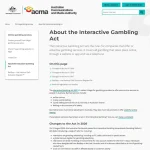
The Australian Communications and Media Authority, usually shortened to ACMA, administers enforcement of the Act. Offshore operators are not made compliant merely by holding a licence in another country: that licence does not replace the requirements that apply under Australian law. Enforcement can also affect whether an offshore site remains accessible from Australia, so a site’s appearance online is not evidence that it is authorised to serve Australian residents.
A further distinction concerns consumer protection. Australian consumer law does not protect players who use offshore casinos. If an account is restricted, a withdrawal is disputed or an operator becomes unavailable, you cannot assume that Australian consumer protections provide a route to resolve the matter. Terms displayed by an offshore operator do not create local protections simply because they are written in English or accept Australian customers.
For someone considering a site that claims to accept Tether, the legal question and the payment question are separate. A cashier showing USDT as an option would not establish that the operator may lawfully offer online casino gambling to people in Australia. Nor would a foreign licence establish Australian authorisation. The rules apply to the service being offered, not to the label attached to its deposit method.
Legal Risk
Under the Interactive Gambling Act 2001, it is illegal for an operator to provide real-money online casino games to people in Australia.
This context is important when assessing claims about offshore casinos: availability, a listed payment option and a foreign licence should not be mistaken for approval under Australian law. The absence of explicit criminalisation of the player does not remove the operator prohibition or extend Australian consumer-law protection to offshore gambling.
Playing With USDT: Payment Preferences in Australia
USDT attracts attention as an alternative payment method, but it sits outside the everyday options many Australians already use. Contactless payments by credit or debit card are available in nearly every part of the country. Mobile wallets, including Google Pay and Apple Pay, are similarly common. These habits matter because they set a familiar baseline: people can often pay by tapping a card or phone rather than handling cash or entering account details.
Australian consumers are also accustomed to moving between different payment types. A card may suit one purchase, a mobile wallet another, and a service connected to a bank account, such as PayPal, a third. That flexibility is part of the local payment environment. A person considering a casino that claims to take Tether is therefore comparing it with methods already integrated into routine spending, not with a single standard way of paying.
The difference is not simply whether a method is digital. Cards, phone wallets and bank-linked services are familiar interfaces: you select a saved or available method and follow its prompts. USDT involves a cryptocurrency payment process, so the name of the currency alone does not tell you how a particular site handles it. A site’s payment instructions would need to explain what the user must do, while the cashier would need to show whether USDT is actually available for the intended transaction.
This distinction helps separate general interest in cryptocurrency from a confirmed payment option. Seeing Tether mentioned in a description does not establish that it can be selected in the cashier, or that it is supported for every payment direction. The familiar Australian options provide a comparison of habits, not evidence that a casino accepts USDT.
Casinos That Accept PayID in Australia: What to Check
If you are comparing methods, look at the choices presented at the point of payment rather than assuming that a digital currency works like a card or wallet. A familiar method may be available because it is widely used in Australia; that does not imply the same reach or handling for Tether. Conversely, widespread card and wallet use does not establish that USDT is unavailable. It only shows that Australians have several established ways to pay, while a crypto option needs to be assessed on its own stated terms.
The practical question is therefore what the cashier actually offers and what its instructions require. A payment method’s broad popularity in Australia cannot confirm its availability at any particular casino. Nor does familiarity with bank-linked services establish that a cryptocurrency payment follows the same steps. Treat each method as a distinct route, and base the comparison on the options and conditions presented for that transaction.
Live-Dealer Games and Unverified USDT Support
A live-dealer table and a USDT payment option describe different parts of an online service. The live table is the game interface: video connects you to a dealer, while software handles your account balance and records wagers. USDT, by contrast, refers to a payment asset used to move value into or out of an account. Seeing one feature mentioned does not establish that the other is available.
Casinos That Accept MiFinity in Australia: What to Check
This distinction matters when a description combines live dealers with cryptocurrency. A platform might describe live tables and separately mention crypto payments, but those statements alone do not show that USDT can fund the account used for those tables. Nor does a USDT option, by itself, show that live-dealer content is available. Each claim concerns a separate function and needs its own clear terms.
If you encounter a claim about live-dealer access with Tether, look for wording that connects the payment method to the account balance rather than merely listing both features on the same page. The cashier and payment terms should identify whether USDT is accepted for account funding. The game information should separately describe the live-dealer offering and any restrictions that apply. Broad labels such as “crypto casino” do not explain how these functions connect.
A further distinction is between a game provider’s supported payment methods and the operator’s cashier. A dealer or game interface may be supplied by another company, while deposits are handled by the casino account. A game appearing in a live section therefore does not establish which assets the cashier accepts. Likewise, a payment logo does not establish that it applies to every part of the service.
Casinos That Accept Apple Pay in Australia
Terms such as “live-dealer Tether casino” can make these separate features sound like one integrated product. Treat them as separate claims instead: live-dealer availability, USDT account funding, and any connection between the two. Unless the relevant terms make that connection explicit, do not assume that a live table can be accessed using a particular cryptocurrency payment method.
Deposits, Withdrawals and Processing Expectations
Deposit and withdrawal timing are separate parts of a payment route. A deposit is the movement of funds into an account; a withdrawal is a request to return funds, which may involve additional checks and processing by the service and payment provider. A claim about one stage does not establish how quickly the other will be completed.
For cryptocurrencies, the available comparison concerns Bitcoin and Ethereum: these can provide instant deposits and withdrawals with limited or no fees. That general statement does not establish the timing or cost of a USDT transfer. A claim that a USDT payment is instant, or that a withdrawal has no fee, needs to specify the relevant payment route and the conditions that apply. Without those details, “fast” does not tell you when funds will arrive or what you will pay.
Casinos that accept Bitcoin Cash (BCH) in Australia
Bank transfers may take longer and involve higher fees, according to a specialist review. This is a comparison, not a timetable for a particular transfer. Processing can depend on the service and the banks involved, so the comparison does not establish a fixed delay or charge for every transaction.
When checking a payment claim, separate the stages and costs: how a deposit is credited, how a withdrawal is processed, whether a fee applies at either stage, and whether the stated timing refers to processing or receipt. A service’s processing time and the time taken for funds to reach your own account are not necessarily the same thing. Look for terms that explain which stage a quoted timeframe covers and which party may charge a fee.
For USDT specifically, do not treat Bitcoin or Ethereum comparisons as proof of equivalent performance. The currency name alone does not establish processing speed, withdrawal availability or fees. If those details are not clearly stated for the exact route, you cannot infer them from a general claim about cryptocurrency payments.
Which online casinos accept American Express for deposits?
Jackpot City Casino, Spin Palace, Ruby Fortune, Ignition Casino, Joe Fortune and PlayAmo are among the sites that support Amex deposits for Australian players.
Does American Express work for online casinos?
Yes, some Australian online casinos accept American Express deposits. You select Amex in the cashier, enter your card details and deposit amount in AUD, then submit the payment.
How long do Amex casino deposits take to process?
Amex casino deposits are processed instantly.
Are there any fees associated with using American Express at online casinos?
Amex deposits typically have no fee, but a casino may add a 1.5% surcharge, and Amex cards incur a 3% currency conversion fee. Withdrawal fees may also apply.
Why does my Amex deposit get declined at some casinos but not others?
Amex may block payments to a particular website, and Australian banks may also block gambling-related transactions on Amex cards.
Can I withdraw winnings directly to my American Express card?
Some casinos allow Amex withdrawals, but not all; you generally need to have deposited with Amex first. Withdrawals can take up to five days to clear, and a fee may apply.
AUD Banking and Payment Methods at VoltRush Casino Australia

Instant AUD Deposit Options at VoltRush Casino Australia
Volt Rush Australia Guide Deposits in Australia VoltRush supports AUD as an account currency, and...

Fast Payouts and VoltRush Cashier Withdrawals in Australia
Volt Rush Australia Guide Withdrawals VoltRush normally expects withdrawals to return to the same payment...

$1 Minimum Deposit Casinos in Australia: What to Know
A stated minimum is only one threshold: payment processors and account crediting can affect whether...

$1 Minimum Deposit Pokies in Australia: How It Works
The cashier’s stated minimum can differ from the payment service’s transaction floor, so a displayed...

$10 Minimum Deposit Casinos in Australia: Payment Rules
The usable minimum depends on the payment route and processor, so a figure shown for...

$10 Minimum Deposit Pokies in Australia
The operator’s cashier and each payment processor can apply different deposit limits, so a $10...

$2 Minimum Deposit Casinos in Australia: Payment Limits
Casino, processor and payment-method limits can differ, while bonus terms and withdrawal rules may affect...

The $20 Minimum Deposit at Australian Casinos
A stated minimum may come from the payment method rather than the casino, so the...

$20 Minimum Deposit Pokies in Australia
The effective minimum can depend on the selected payment method and its processing route, not...

$5 Minimum Deposit Casinos in Australia: What to Know
A stated deposit minimum may not apply to every payment route or leave a balance...

$5 Minimum Deposit Pokies in Australia: How It Works
A successful deposit depends on both the casino cashier’s minimum and the separate threshold set...

Anonymous Crypto Casinos in Australia: Risks and Rules
A practical look at offshore access, crypto payment costs, Australian legal limits and why deposits...

Aristocrat Online Pokies in Australia: What to Know
The term can point to a search topic, but it does not establish a specific...

Aussie Crypto Casinos: Payments, Checks and Risks
A practical look at transfers, Australian legal context, verification limits, identity checks and bonus claims...

Best New Australian Online Pokies: What “New” Means
The term “new” can mean a recent release, a catalogue addition or a game that...

Online Casino Payment Methods for Australian Players
Deposit and withdrawal routes can differ, so payment availability, provider conditions and processing times should...

Online Pokies Australia: What “Best Paying” Claims Mean
A practical distinction between slot results, withdrawal handling, Bitcoin crediting and the conditions that can...

Bitcoin Pokies in Australia: Payments and Risks
A practical guide to payment units, offshore legal context, bonus rules, transaction steps and common...

Amex Casino Sites in Australia: Deposits and Payouts
Amex availability depends on the casino cashier, while deposit rules, declined payments and withdrawal routes...

BPAY Casino Sites in Australia: What Acceptance Means
Familiarity with BPAY does not confirm that a casino accepts it, supports withdrawals through it...

Casino Sites That Accept Credit Cards in Australia
Card availability depends on the casino, card network and issuer, so a listed payment option...

EcoPayz casino sites in Australia: legal and payment checks
EcoPayz availability is only a cashier detail; it does not show whether an offshore casino...

Osko at Australian Casino Sites: What Can Be Verified
Australian payment habits offer context, but each site's available methods, withdrawal terms and approval conditions...

Paysafecard Casinos in Australia: What to Check
Everyday payment habits do not confirm a casino cashier accepts Paysafecard or provides a matching...

Skrill Casino Sites in Australia: Legal and Payment Checks
A framework for assessing payment acceptance, withdrawal availability and the legal boundary for real-money casino...

Trustly casino sites in Australia: what to verify
A payment option does not establish that an offshore casino may serve Australians or that...

Casinos That Accept Apple Pay in Australia
Everyday mobile-wallet use does not show whether an online casino supports Apple Pay or how...

Casinos That Accept Bitcoin in Australia: How BTC Works
Bitcoin casino balances sit in the operator’s account system, while deposits and withdrawals move through...

Casinos that accept Bitcoin Cash (BCH) in Australia
A practical guide to checking BCH payment details, bonus conditions, withdrawals, and the limits of...

Casinos That Accept CashToCode in Australia
A CashToCode listing alone does not confirm casino acceptance, withdrawal support, or availability across games...

Casinos That Accept Ethereum (ETH) in Australia
An ETH option describes how value moves, not which games are offered or whether a...

Casinos That Accept Google Pay in Australia
A listed wallet option is only one part of a transaction, and says little by...

Casinos That Accept Litecoin in Australia
A framework for checking currency support, transaction direction, bonus and game claims, and the limits...

Casinos That Accept Mastercard in Australia
Everyday card acceptance is separate from an online casino’s payment settings, so verify deposit and...

Casinos That Accept MiFinity in Australia: What to Check
A listed payment option does not establish a working deposit route, withdrawal timing, game availability...

Casinos That Accept Neosurf in Australia
A Neosurf mention does not confirm that an operator offers pokies, accepts deposits from Australian...

Casinos That Accept Neteller in Australia: Key Checks
Neteller availability depends on the operator’s payment terms and customer location, not simply on a...

Casinos That Accept PayID in Australia: What to Check
Learn how to distinguish a direct PayID payment claim from general site descriptions, and what...

Casinos That Accept PayPal in Australia: What to Check
PayPal availability depends on the operator and customer, and payment support alone does not confirm...

Casinos That Accept POLi in Australia: What to Check
A POLi label alone does not establish that an online casino offers the method, games...

Casinos That Accept Visa in Australia: What to Know
Visa availability, deposit claims and card withdrawal limits are distinct questions in Australia’s online gambling...

Dragon Link Online Pokies in Australia: Bitcoin Guide
The Dragon Link label does not confirm that a digital version exists, accepts Bitcoin, or...

Easy Withdrawal Casinos in Australia: Payment Times
Cashout timing depends on both the casino’s approval checks and the payment method’s transfer speed....

Fast casino withdrawals in Australia: payout stages
A withdrawal can involve operator approval, a payment route and receiving-bank processing, with transfer speed...

Instant Bank Transfer Casinos in Australia: How They Work
Follow the transfer from casino payment page to banking app, and see how deposit checks,...

Instant PayID Withdrawals in Australia: How They Work
A PayID transfer can move in real time once released, while casino approval and review...

Instant PayID Withdrawals for Real Money in Australia
PayID directs the payment, while platform approval and the bank transfer each affect when funds...

Low-Deposit Online Casinos in Australia: Payment Limits
The amount you can deposit depends on both the casino’s setting and the payment route,...

PayID Pokies in Australia: Payments Explained
PayID is a payment identifier, while banks and the NPP handle transfers; casino terms affect...

No-ID-Verification Casino Withdrawals in Australia
A withdrawal can remain pending during operator review, and a payment-method estimate may cover only...

No-KYC Casinos in Australia: Crypto Cashouts
Crypto networks move payments, but casino acceptance, withdrawal checks and bonus conditions can affect when...

No Minimum Deposit Casinos in Australia: What It Means
A casino may set no deposit minimum, but payment routes can have their own limits...

Online Pokies Instant Withdrawals in Australia
A withdrawal can move quickly after approval, while account checks and balance conditions may delay...

Online Pokies PayID in Australia: Payment Guide
A practical guide to confirming casino PayID support, deposit thresholds, bank transfers, withdrawals and offer...

Pay by Phone Casinos in Australia: What It Means
PayID uses a bank-linked identifier through the New Payments Platform, unlike a charge billed by...

Quick Withdrawal Casinos in Australia: Payment Routes
Payment route, casino approval and identity verification all affect when a requested withdrawal can be...

Real Cash Online Pokies in Australia: Bitcoin Guide
Bitcoin identifies a payment option, while pokies describe the game format; the distinction shapes how...

Safe Online Pokies in Australia: Risks and Rules
Game fairness, payments, privacy and legal status are separate concerns, and using Bitcoin does not...

Same-Day Casino Payouts in Australia: How They Work
A withdrawal can involve operator checks, payment processing and bank handling, so a fast transfer...

Solana Casino Comparison for Australia
A practical look at moving AUD through an exchange into SOL, alongside offshore access, bonus...

Under-One-Hour Casino Withdrawals in Australia
A withdrawal’s total time depends on operator release as well as the payment network, so...